Track Record: Mold Correction Technology
Using deviation from the design shape
to correct the mold.
A technology that modifies the shape of the mold surface so that molded items, which shrink and deform as they cool, come closer to the design shape. This technology led to a partnership agreement with a mid-sized manufacturer.
Service Overview
Smooth corrected shapes at a world-leading level, achieved by a new algorithm*
* To the best of the Representative's (Ph.D.) knowledge
Mold Correction and Its Usefulness
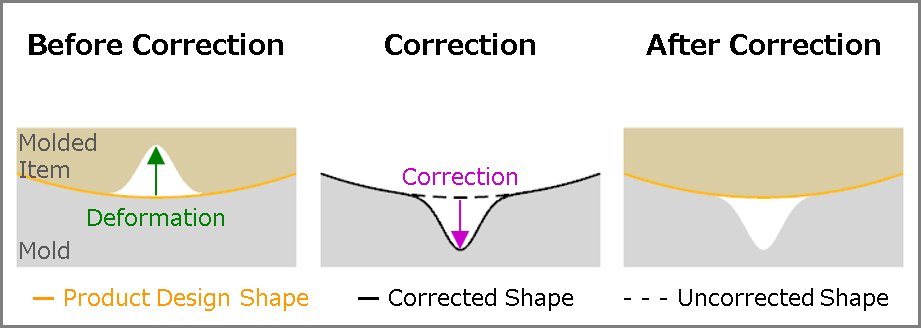
Mold correction is the design act of modifying the design shape of molding surfaces so that the shape of molded items that shrink and deform during cooling approaches the design shape of molded products (see Fig. 1). With a technology that can perform this accurately, it becomes possible to manufacture high-quality molded items that meet shape specifications even under low-cost molding conditions that are disadvantageous for meeting them, which improves the feasibility of mass production of molded products.
Existing Mold Correction Technologies and Their Problem
Mold correction technologies can be roughly divided into the following three types.
-
Shapes Represented by Analytical Functions
A mold correction technology applicable to shapes represented by analytical functions (see a 1992 paper)
-
Shapes Represented by Polygons
A mold correction technology applicable to shapes represented by polygons (see a 2015 paper)
-
Shapes Represented by NURBS
A mold correction technology applicable to shapes represented by NURBS (another company's product)
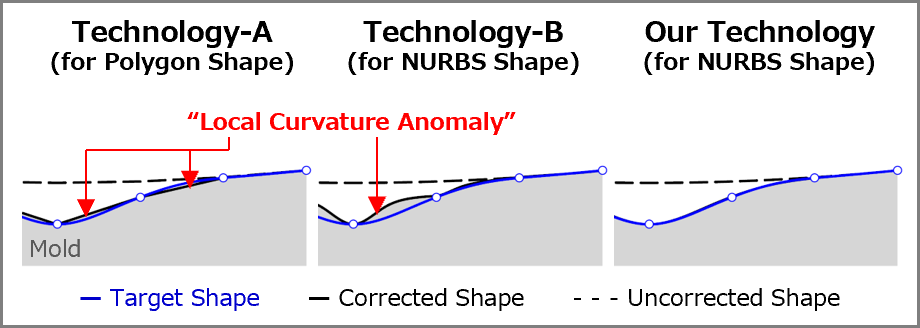
The third technology (the "NURBS Representation Type" mold correction technology) is the most technically difficult, and as a result it offers the highest degree of freedom in applicable shapes and is the most convenient in subsequent processes. However, as far as the Representative knows, existing mold correction technologies have a troublesome property of causing local unintended curvatures in the corrected shape ("Local Curvature Anomaly") (see Fig. 2, left and middle). It is almost impossible to remove this "Local Curvature Anomaly" in a subsequent process.
Our Mold Correction Technology and Its Usefulness
Unlike existing mold correction technologies, our "NURBS Representation Type" mold correction technology does not cause "Local Curvature Anomaly" (see Fig. 2, right). This technology can greatly improve the feasibility of mass production of molded products whose surface shape has a strong influence on performance.
Service Quality
As an example, we introduce the quality of the mold correction service for grid-shaped output data.
Correction amount (three shapes)
500μm
Correction error
1μm or less
Service Content and Fees
Service Content
Based on shape evaluation data of a molded item (= data showing the amount of deformation of the molded item from the design shape), we correct the 3D-CAD model shape of the mold surface using the mold correction technology we developed (= a numerical calculation program)*.
* Format of CAD data accepted from customers (format of CAD data provided to customers): STEP [AP203 or AP214] (STEP [AP203])
Service Fees
We provide a mold correction service suited to the output data of the 3D shape measuring machine owned by the customer (please contact us). Mold correction services customized for each customer are offered from JPY 80,000 (excl. tax).
Our Representative will explain
the mold correction technology.
Our Representative will personally address the details of the technology and whether it can be applied. Please tell us about the shape data and the challenges involved. We will reply within 3 business days.
Consult Us About Mold Correction